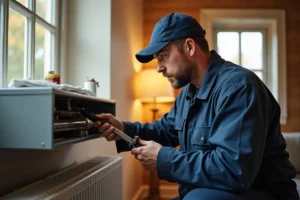

Professional Maintenance Is the Only Way to Ensure Your Home Stays Warm This Winter
When the first frost hits the Wasatch Front and the temperatures in Salt Lake City begin their inevitable plummet, your home’s heating system transitions from a background player to the most critical infrastructure in your life. For many Utah homeowners, that infrastructure is a boiler. Unlike forced-air furnaces, boilers provide a unique, gentle radiance that keeps a home cozy even when the wind is howling off the Great Salt Lake. However, because they are complex systems involving pressurized water, gas lines, and intricate electrical controls, they require a specific type of care.
Understanding the necessity of a professional boiler service in Utah is not just about home comfort; it is about safety, fiscal responsibility, and system longevity. In the high-altitude, hard-water environment of the Beehive State, neglect is the leading cause of premature system failure. This guide explores why professional intervention is the only reliable way to protect your investment and your family.
The Unique Challenges of Operating a Boiler in Utah
Utah’s climate and geography present a “perfect storm” of conditions that can stress a boiler system more than in other parts of the country. To understand why professional service is mandatory, one must first look at the environmental factors at play.
1. The Hard Water Factor
Utah is notorious for its “hard” water—water that is densely packed with minerals like calcium and magnesium. While safe to drink, these minerals are a boiler’s worst enemy. As water is heated within the boiler’s heat exchanger, these minerals precipitate out, forming a hard crust known as “scale.”
Scale acts as an insulator. When it coats the inside of your heat exchanger, the burner has to run longer and hotter to get the water to the correct temperature. This doesn’t just raise your gas bill; it causes the metal to overheat and eventually crack. A professional service technician uses specialized descaling agents to flush the system, a process that is far beyond the scope of a standard DIY project.
2. Extreme Temperature Swings
Utah experiences significant “diurnal” temperature shifts—massive swings between day and night. In the spring and fall, a boiler might sit idle during a sunny 65°F afternoon and then be forced to kick into high gear when the temperature drops to 25°F at 3:00 AM. These rapid cycles of heating and cooling cause the metal components to expand and contract frequently. Over time, this leads to loose connections and weakened seals.
3. High Altitude Combustion
At 4,000+ feet above sea level, there is less oxygen available for combustion. If a boiler is not properly “derated” or tuned for high-altitude operation, it will burn fuel inefficiently. This results in “sooting”—a buildup of carbon deposits on the burner and heat exchanger. Soot further reduces efficiency and can eventually lead to dangerous carbon monoxide production.
What Happens During a Professional Boiler Service?
A common misconception is that a boiler service is just a quick “look-see.” In reality, a comprehensive service involves a multi-point inspection and cleaning process that ensures every mechanical and chemical balance is correct.
Combustion Analysis
Using a digital analyzer, a technician measures the gases leaving your flue. They check the levels of oxygen, carbon dioxide, and, most importantly, carbon monoxide. This ensures the fuel-to-air ratio is perfect. If the CO levels are too high, the technician can adjust the gas valve or clean the burner to bring the system back into a safe operating range.
Testing Safety Controls
Boilers are equipped with several “fail-safe” devices. The Pressure Relief Valve (PRV) is designed to open if the pressure inside the tank gets too high, preventing a catastrophic explosion. The Low Water Cut-Off (LWCO) ensures the burner shuts down if the water level drops, preventing the unit from “dry-firing” and melting the heat exchanger. During a professional service, these safety devices are manually tripped to ensure they are not seized or corroded.
Expansion Tank Calibration
As water heats up, it expands. The expansion tank provides a “cushion” of air to absorb this extra volume. If the tank loses its air charge (becomes “waterlogged”), the system pressure will spike every time the boiler turns on. A technician will check the pre-charge pressure of this tank to ensure your pipes aren’t under unnecessary stress.
The Financial Benefits of Annual Maintenance
While some homeowners view a service call as an unnecessary expense, the data suggests it is actually a cost-saving measure. According to the U.S. Department of Energy, regular maintenance can improve a heating system’s efficiency by up to 15%.
| Benefit | Impact of Regular Service | Impact of Neglect |
| Monthly Bills | Lower (10-15% savings) | Steadily increasing |
| Repair Costs | Minor (part replacements) | Major (emergency 24/7 calls) |
| System Lifespan | 15–25 years | 8–12 years |
| Warranty Status | Remains Valid | Likely Voided |
Warranty Protection
Most modern boiler manufacturers, such as Navien, Lochinvar, or Viessmann, explicitly state in their warranty terms that a licensed professional must service the unit annually. If your heat exchanger fails in year five but you have no record of professional maintenance, the manufacturer may deny your claim, leaving you with a $5,000+ bill.
Recognizing the Signs That Your Boiler Needs Immediate Attention
Even with annual service, parts can wear out. Utah homeowners should be vigilant for these “warning shots” from their heating system:
- Kettling: If your boiler sounds like a tea kettle (a low-pitched rumbling or whistling), it’s a sign of heavy limescale buildup. The water is actually turning to steam trapped behind the scale, which can damage the heat exchanger.
- Frequent Cycling: If the boiler turns on and off every few minutes, it may be “short-cycling.” This is often caused by a faulty thermostat, an oversized boiler, or a failing internal pump.
- Yellow Flame: A healthy gas burner should produce a crisp blue flame. A yellow or orange flame indicates incomplete combustion and a high risk of carbon monoxide.
- Pooling Water: Any moisture around the base of the unit is an emergency. Boilers are closed-loop systems; if water is getting out, air is getting in, which leads to rapid internal corrosion.
Pro Tip: Never attempt to tighten gas fittings or adjust internal gas valves yourself. These components require calibrated tools to set correctly.
The Importance of “System Water” Chemistry
The water inside your radiators is not the same as the water in your tap—or at least, it shouldn’t be. In a professional boiler service, the technician doesn’t just look at the machine; they look at the fluid inside it.
Over time, the water in your heating loop can become “dead water.” Without the right inhibitors, this water reacts with the different metals in your system (copper, cast iron, aluminum) to create a black sludge known as magnetite. This sludge is magnetic and will eventually find its way into your circulator pump, seizing the bearings and killing the motor.
Professional technicians can perform a “Power Flush” or add chemical inhibitors to the system. These chemicals create a microscopic film inside your pipes, preventing the chemical reaction that causes sludge. This is a critical step for Utah homes with older cast-iron radiators, as these systems are particularly prone to internal rusting.
Safety First: The Carbon Monoxide Risk
Because boilers burn fuel (typically natural gas or propane) within an enclosed space, the risk of carbon monoxide (CO) poisoning is real. CO is often called the “silent killer” because it is colorless, odorless, and tasteless.
Professional service includes a thorough inspection of the venting system. In Utah, heavy snow can sometimes block the plastic PVC vents of high-efficiency boilers. Furthermore, older brick chimneys can crumble internally, blocking the exhaust of traditional “natural draft” boilers. A technician will ensure the vent has the proper pitch to drain acidic condensate and that there are no leaks in the seams of the flue pipe.
Investing in Peace of Mind
At the end of the day, a boiler service is more than mechanical parts and gas pressures. It is about the peace of mind that comes from knowing your home will remain a sanctuary, regardless of how low the temperature drops outside. By addressing scale buildup, calibrating combustion, and ensuring safety controls are operational, you are protecting your family and your wallet.
Utah’s winters are beautiful, but they are unforgiving. Don’t wait for the first blizzard of the season to learn your heating system isn’t up to the task. Proactive maintenance is the hallmark of a responsible homeowner and the only way to ensure your boiler runs efficiently for decades to come.